


Few people know this, but I went to college to be an English teacher. Bright-eyed, highlighter in hand, fully ready to teach Shakespeare for the rest of my career. The horror. But about a year and a half in (while analyzing Beowulf, of all things 😵💫), I had an epiphany: I was meant for something else.
What I didn’t expect was how much those English major days would follow me. My professors hammered some things in my brain that I’ve never forgotten. And honestly, thank goodness. Because it turns out a lot of what they taught me applies directly to how to write a good blog post.
You don’t need an English degree. You just need the cheat sheet. Consider this yours. 😉
📌 Love these ideas? Pin this post for later!
8 Tips for How to Write a Good Blog Post
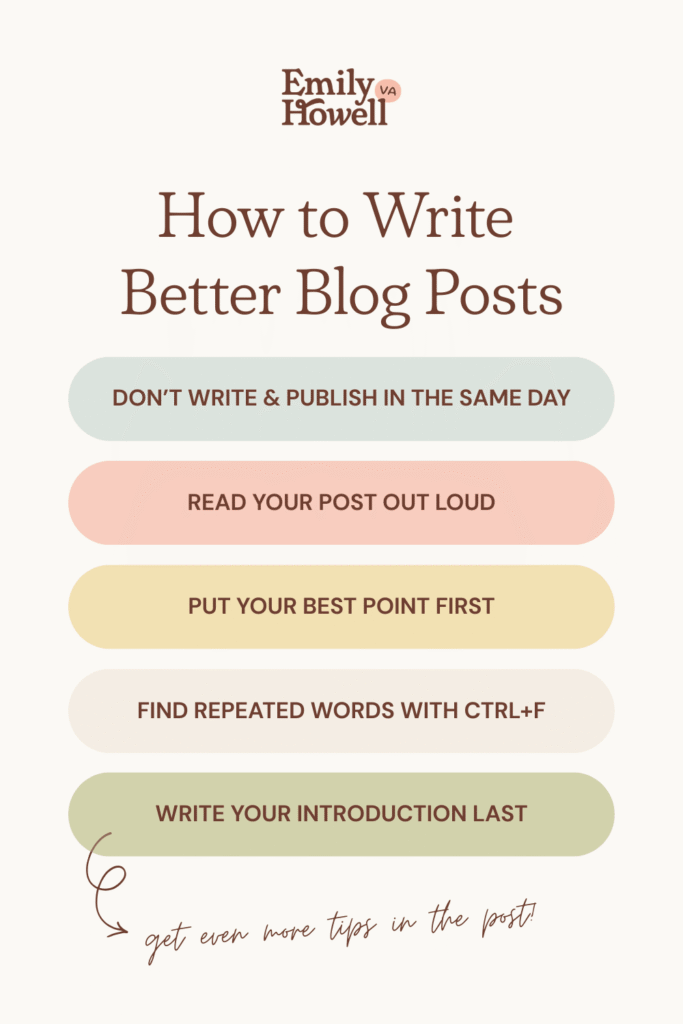
1. Don’t Write and Publish in the Same Day
The number one thing I tell people who ask me how to write a good blog post: don’t write and publish in the same day. When you finish writing something, your brain is still way too close to it. It’s whispering to you, “Oh yesss…this is perfect,” when in reality, your writing is likely hiding typos and clunky sentences.

Turn your computer off, get a good night’s sleep, and proofread it the next day. (Tip #2 shows you my preferred way of proofing.) If you can’t wait a whole day, even a few hours makes a big difference.
2. Read It Out Loud
This next point goes hand in hand with the first. Your eyes tend to skip over errors that your ears can’t. Reading your post out loud is an easy way to catch confusing sentences, repeated words, or paragraphs that don’t quite flow.
If you stumble over something while reading it out loud, your reader will probably stumble over it too. Read it out loud like you’re talking to a friend, fixing errors as you go.
3. Write Your Intro Last
Counterintuitive? Perhaps. But your intro exists to set up everything that follows. It’s really hard to write a setup when you’re not sure exactly where you’re going yet.
So, write your body content first. Get your tips, your story, your points all out on the page. Then go back and write an intro that reflects what the post became. It’ll feel like way less of a struggle.
4. Pick a Main Point and Come Back to It
Thesis, main point…whatever you want to call it. Your post needs one.
Before you start writing, ask yourself: what is the one thing I want my reader to walk away knowing? Write that down. Then, as you work through your post, keep checking back in with it.
✅ Does this paragraph support that point?
✅ Does this section feel like it belongs?
It doesn’t have to be formal or stiff — this is a blog, not a five paragraph essay, for goodness’ sake! But having that main point to refer back to keeps you from writing something that doesn’t quite fit.
5. Check for Word Overuse with CTRL+F
We all have filler words and phrases we default to without realizing it. (Mine’s “so”… what’s yours? 😅) Whatever your phrases are, overusing them can make your writing sound awkward and repetitive.
SO… make CTRL+F your best friend. Use it to search for your usual offenders. Then, use it again while you’re proofreading out loud and come across a repeated word. Chances are you’ve used it more than twice.
Can’t think of any way else to say it? Use a thesaurus!
📌Inspired by these ideas? Pin this post for later!
6. Read More to Become a Better Writer
This tip was one I picked up wayy back in high school English.
Reading makes you a better writer.
The more you read (blogs, books, Substack, anything!) the more you absorb different ways of stringing sentences together, building a point, and keeping a reader’s attention.
You don’t have to read academic texts (unless you want to). Find and read blogs you love. Notice what makes them work. Pay attention to specific things you admire about the writing, and then emulate it in your own.
7. Turn Off Your Inner Critic
There is a quote that’s attributed to Ernest Hemingway that I’m obsessed with: write drunk, edit sober.
The point isn’t to actually pour yourself a pint before you open WordPress. (Okay, that actually sounds amazing. 🍻) It’s about separating your creative brain from your critical brain.
When you write, just write.
Get it all out without stopping to fix every sentence. Editing while you’re still drafting kills momentum and makes the whole process feel way harder than it needs to be. Give yourself permission to write messy. The clean-up comes later.
FIELD NOTE: Did you know there actually is a website called Hemingway? You can use it to check that you’re writing simple enough for the masses (8th grade reading level).
8. Put Your Best Point First (and Your Second-Best Last)
Finally, a little psychology trick I picked up along the way is super applicable to your writing: the primacy-recency effect. Basically, people remember what they read first and what they read last far better than everything in the middle.
That means the order of your points actually matters. Don’t save your best for last.
💡 Lead with your strongest, most valuable tip. It’ll hook the reader and set a high bar for the rest of the post. Then, close with your second-strongest. (Kind of like I did here. 😉) Chances are it’ll be the thing they remember.
And the middle? That’s where your solid-but-not-flashy content lives. Your readers will still absorb it; they just won’t remember it as vividly. If you’ve got a point to drive home, this is the way to do it.
Still Dreading Your Blog? Let’s Fix That.
Learning how to write a good blog post doesn’t require an English degree or a natural gift for writing. It requires a little strategy, a few tricks, and a willingness to try. And it turns out, you didn’t need to sit through Beowulf to figure that out.
If you’d rather skip the learning curve altogether, that’s what I’m here for. I offer SEO blog writing services for creatives who have better things to do. Get in touch here or check out my services. I’d love to take it off your plate.


+ Show Comments
- Hide Comments
add a comment